Introduction
AI model deployment is moving from occasional batch releases to continuous delivery, much like software. GitOps and MLOps can automate model builds, tests and production releases while supporting traceability, regulatory compliance (RGPD, IA Act) and immediate rollback. The architecture uses tools such as Argo CD, Flux, Tekton and Kubeflow Pipelines, and raises governance and risk questions for the teams involved.
Introduction
Imagine a bank that trains a fraud detection model daily using real-time transactional streams. Each iteration improves the detection rate: 0.85% → 0.92%. However, production deployment must remain secure, audited, and reversible to avoid sanctions (GDPR, IA Act) or major financial impacts. Until now, AI teams have delivered their models via ad-hoc scripts, often stored in shared folders, lacking reliable versioning or granular access control.
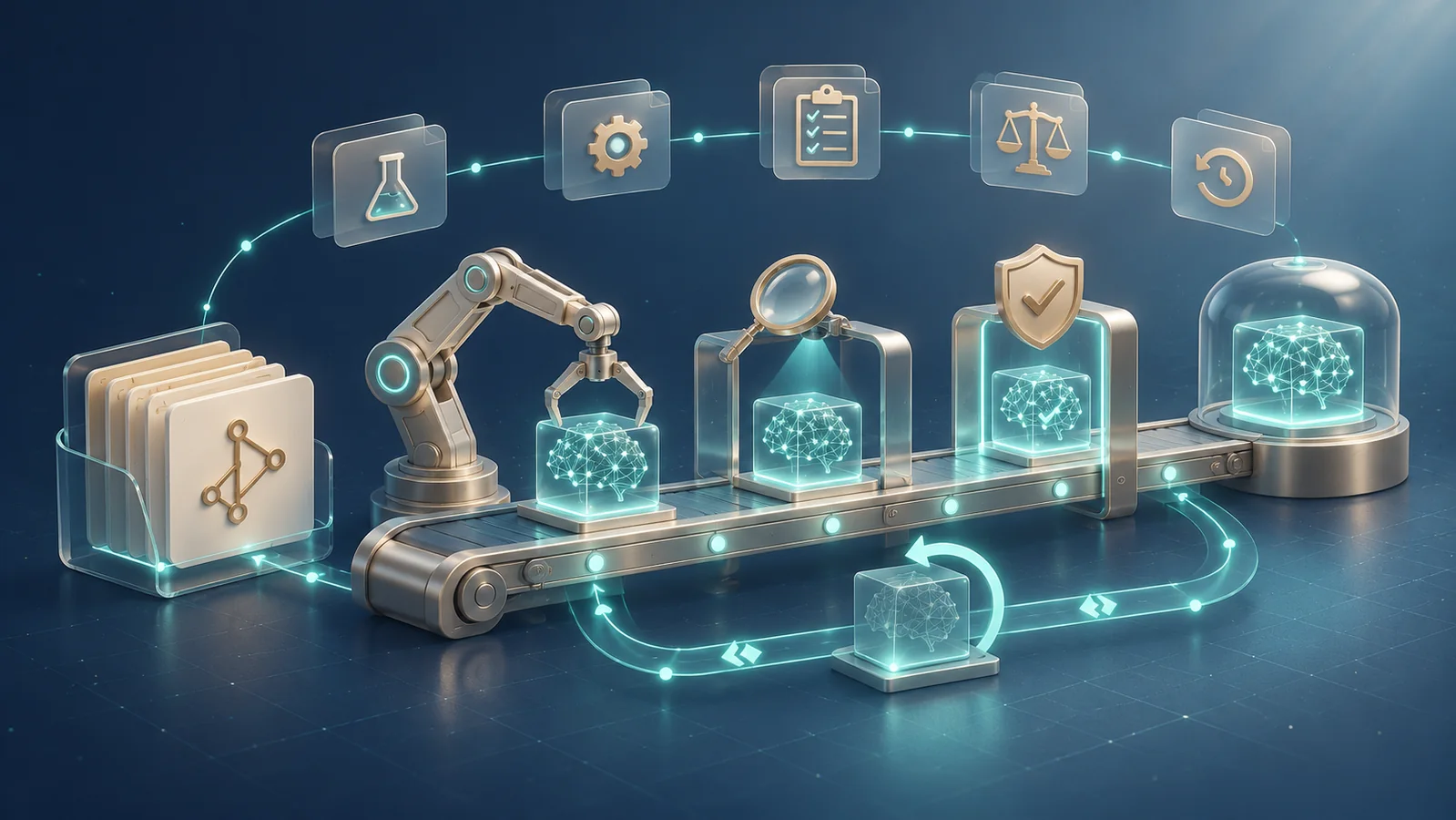
The GitOps paradigm – defining the desired state of the system in a Git repository and allowing an automated operator to reconcile it with reality – provides a robust solution. By extending this principle to machine learning artefacts (datasets, models, pipelines), we achieve continuous deployment where every commit triggers the construction of an automated pipeline, compliance validation and, in the event of failure or detected anomalies, an instantaneous rollback to the previous version.
For business executives, CIOs/AI-CIOs, CISOs, cloud architects and DevSecOps teams, the aim is to make ML workflows reliable, auditable and reversible through continuous GitOps-based deployment.
1. Context: why continuous deployment of AI models has become essential
| Factor | Impact on the organisation |
|---|---|
| Training frequency (e.g. daily or hourly) | The need to automate the end-to-end chain to avoid human bottlenecks. |
| Regulations (GDPR, IA Act) | Requirement for traceability of data and model versions, as well as bias controls prior to production deployment. |
| Cost of downtime | A faulty model can lead to financial or reputational losses; instant roll-back thus becomes a critical resilience criterion. |
| Complexity of hybrid cloud environments | Consistent management of artefacts across multiple Kubernetes clusters, compute servers, and model registries. |
These factors converge on the need for a framework that:
- guarantees that every change (code, hyperparameters, dataset) is versioned in Git;
- automatically triggers a build, test, and validation pipeline;
- ensures deployment to the target infrastructure (Kubernetes, dedicated servers, etc.) via declarative operators;
- provides an immediate roll-back capability in the event of an anomaly.
2. GitOps Principles Applied to AI
GitOps is based on three pillars: declaration, versioning, and automated reconciliation [1]. When transposed to AI models, these result in:
| Pillar | AI Implementation |
|---|---|
| Declaration | The pipeline configuration (Dockerfile, Helm chart, Tekton Pipeline) as well as the model manifest (YAML describing the Docker image, model registry, CPU/GPU resources) are stored in Git. |
| Versioning | Each commit creates a new revision of the training code, parameters, and dataset (via DVC or Git-LFS). The trained model is pushed to a registry (MLflow, ModelDB) with an immutable hash referenced in the manifest. |
| Reconciliation | An operator (Argo CD or Flux) monitors the repository; as soon as a new commit appears, it applies the manifest to the Kubernetes cluster, triggering the creation of the inference pod or the replacement of the version currently in service. |
Thus, the desired state of the AI system – 'model v1.3-prod running image my-model:sha256…' – is always reflected in Git, ensuring auditability and reproducibility.
3. Typical CI/CD pipeline architecture for AI models

Read the diagram notation
graph LR
    A[Git Repository] -->|Commit| B["CI (Tekton / GitHub Actions)"]
    B --> C[Build Docker Image + Push to Registry]
    B --> D["Run Training Job (Kubeflow, Vertex AI)"]
    D --> E["Register Model (MLflow) + Tag SHA"]
    E --> F["Generate Deployment Manifest (Helm Chart)"]
    F --> G[Push Manifest to GitOps Repo]
    G --> H[Argo CD / Flux –> Reconcile on Cluster]
    H --> I[Canary Deployment → Observability]
    I --> J{Validation OK ?}
    J -- Yes --> K[Promote to Prod]
    J -- No --> L["Rollback (Git revert) + Alert"]
3.1 Detailed steps
| Step | Typical tools | Objectives |
|---|---|---|
| Code & Data Management | Git, DVC, Git‑LFS | Version training scripts, dependencies, and dataset snapshots (e.g., data/v1.2/). |
| CI – Build | Tekton, GitHub Actions, GitLab CI | Build the Docker image containing the inference code and libraries (TensorFlow 2.x, PyTorch 1.13). |
| Automated Training | Kubeflow Pipelines, Vertex AI Training, Azure ML | Execute the training job in a GPU cluster; publish the model artifact to a registry (MLflow, S3). |
| Model Packaging | MLflow Model Registry, Docker‑based model server (TensorFlow Serving, TorchServe) | Tag the model version with the Git hash and performance metadata. |
| Manifest generation | Helm, Kustomize | Create a model-deployment.yaml file declaring the image, resources, and health probes. |
| GitOps – Deployment | Argo CD, Flux | Apply the manifest to the target cluster; ensure convergence between the Git state and the cluster. |
| Canary / Blue‑Green | Flagger, Istio, Linkerd | Deploy progressively (e.g., 5% of traffic) to monitor inference metrics (latency, error rate). |
| Compliance validation | Great Expectations, Evidently AI, Seldon Deploy | Execute bias and robustness tests, and verify adherence to personal data budgets prior to promotion. |
| Instant rollback | Git revert + Argo CD sync-option --prune | If an anomaly is detected, the previous manifest is restored; the pipeline reapplies the stable version with zero downtime. |
4. Automation: which tools to choose and why?
| Domain | Recommended tool(s) | Key strengths |
|---|---|---|
| GitOps Orchestration | Argo CD (CNCF) – rich UI, Helm & Kustomize support; Flux v2 – native integration with GitHub and OCI registries. | Declarative reconciliation, change auditing via Git diff, native rollback (Rollback UI). |
| CI/CD pipelines | Tekton (CNCF) – Kubernetes-native pipelines, extensible; GitHub Actions – simplicity for small projects; GitLab CI – end-to-end lifecycle management. | Step isolation within Pods, artefact cache support, UI visibility. |
| Model training & management | Kubeflow Pipelines, MLflow Model Registry, Vertex AI Pipelines. | Metrics tracking (accuracy, fairness), immutable versioning, promotion between environments. |
| Observability and validation | Prometheus + Grafana, Evidently AI, Great Expectations, Seldon Deploy (inference monitoring). | Early detection of concept drift or regulatory threshold violations. |
| Secrets & supply-chain management | Sealed Secrets, HashiCorp Vault, Cosign (image signing), SLSA (Supply-Chain Levels for Software Artifacts). | Guarantee of artefact integrity, provenance traceability. |
The choice depends on the level of cloud maturity (public vs private) and internal skill sets: organisations already invested in the CNCF ecosystem will prefer Argo CD + Tekton; those heavily anchored in GCP may rely on Vertex AI Pipelines while maintaining GitOps principles via Cloud Build triggers.
5. Compliance validation: from technical testing to legal governance
5.1 Regulatory Framework
- GDPR – transparency requirements, right of access and rectification for data used in training [4].
- AI Act (European Commission) – classification of high-risk AI systems, documentation obligations, pre-deployment testing and post-deployment monitoring [5].
5.2 Automated tests integrated into the pipeline
| Test type | Tools / Methods | Compliance objective |
|---|---|---|
| Data quality | Great Expectations, Deequ | Verify the absence of missing values and demographic biases within the training dataset. |
| Bias and fairness | Evidently AI, AIF360 | Measure performance disparities (FPR/FNR) between protected groups; apply legal thresholds. |
| Robustness / Adversariality | ART (Adversarial Robustness Toolbox) | Simulate input perturbations to ensure model stability against attacks. |
| Compliance with personal data budget | DVC + audit logs | Ensure that the dataset does not exceed the limits of collected consent. |
| Documentation & Traceability | MLflow tags, Git commit SHA, SLSA provenance | Generate a “model card” compliant with ISO/IEC 22989 (MLOps) and AI Act recommendations. |
These steps are executed before the canary; if a violation is detected, the pipeline blocks promotion and generates an incident ticket (e.g. Jira).
5.3 Continuous Governance
A Model Governance Board (comprising data scientists, legal counsel, and CISOs) must validate the reports generated by the tests. The decision for production deployment is recorded in the Git repository via a signed pull request, ensuring legally admissible traceability during an audit.
6. Instant Roll-back: Strategies and Mechanisms
6.1 Why roll-back must be instantaneous
- Model drift: a sudden shift in metrics (e.g., an increase in the false positive rate) can impact regulatory compliance.
- Security incident: a vulnerability discovered in a dependency library (e.g., CVE-2023-XXXX) requires immediate withdrawal.
6.2 Rollback Methods
| Technique | Description | Tools |
|---|---|---|
| Git revert + re-sync | Revert to a previous commit of the manifest; Argo CD automatically applies the previous version. | git revert <sha> → push → Argo CD sync (auto). |
| Canary abort | If canary metrics exceed the threshold, Flagger triggers a rollback to the stable version. | Flagger + Istio/Linkerd. |
| Feature flag | The model is deployed behind a toggle; the new model can be disabled without affecting the underlying deployment. | LaunchDarkly, OpenFeature. |
| Cluster state snapshot | Using etcdctl snapshot save to rapidly restore the Kubernetes configuration. | kubectl rollout undo deployment/<model> or helm rollback. |
The Mean Time To Recovery (MTTR) in a well-configured GitOps pipeline is typically under 30 seconds, as the mechanism relies solely on applying an already versioned manifest.
7. CI/CD/ML Pipeline Security and Resilience: Key Points
| Domain | Primary risk | Recommended countermeasure |
|---|---|---|
| Supply chain | Compromise of a Docker image (malware). | Sign images with Cosign, verify signatures within the Tekton pipeline (cosign verify). |
| Secrets | API key leakage via logs. | Use Sealed Secrets or Vault; inject only at runtime, mask values in CI artefacts. |
| Access control | Unauthorised deployment by a junior developer. | Kubernetes RBAC + OPA/Gatekeeper policies on manifests (e.g. prohibiting modification of resources.limits.cpu without approval). |
| Data integrity | Corrupted or manipulated dataset. | Store snapshots in a versioned bucket with SHA-256 checksum; verify integrity before each training run via DVC. |
| Model registry availability | Model Registry unavailability blocks deployment. | Multi-region replication (MLflow + S3 Cross-Region); fallback to previous artefacts stored in OCI registry. |
These measures integrate seamlessly into GitOps pipelines, strengthening the confidentiality, integrity, and availability of the AI production process (CIA triad).
8. Use Case: Continuous deployment of a banking fraud model
Context
A French bank operates a scoring model based on gradient boosting (XGBoost) to detect fraudulent transactions. The daily dataset comprises 5M rows, updated every night. Regulatory requirements mandate:
- traceability of personal data processing (GDPR);
- validation of the false positive rate (< 0.2%) prior to production deployment (AI Act).
Implemented architecture
- The bank-fraud-ml Git repository contains the training code (train.py), notebooks, and DVC configuration for the datasets.
- CI: GitHub Actions triggers a Tekton job that builds the Docker image fraud-model:sha256….
- Training: Kubeflow job on a GKE cluster with T4 GPUs, output recorded in MLflow (version v1.7).
- Compliance tests: Evidently AI pipeline measures country-specific bias and drift