
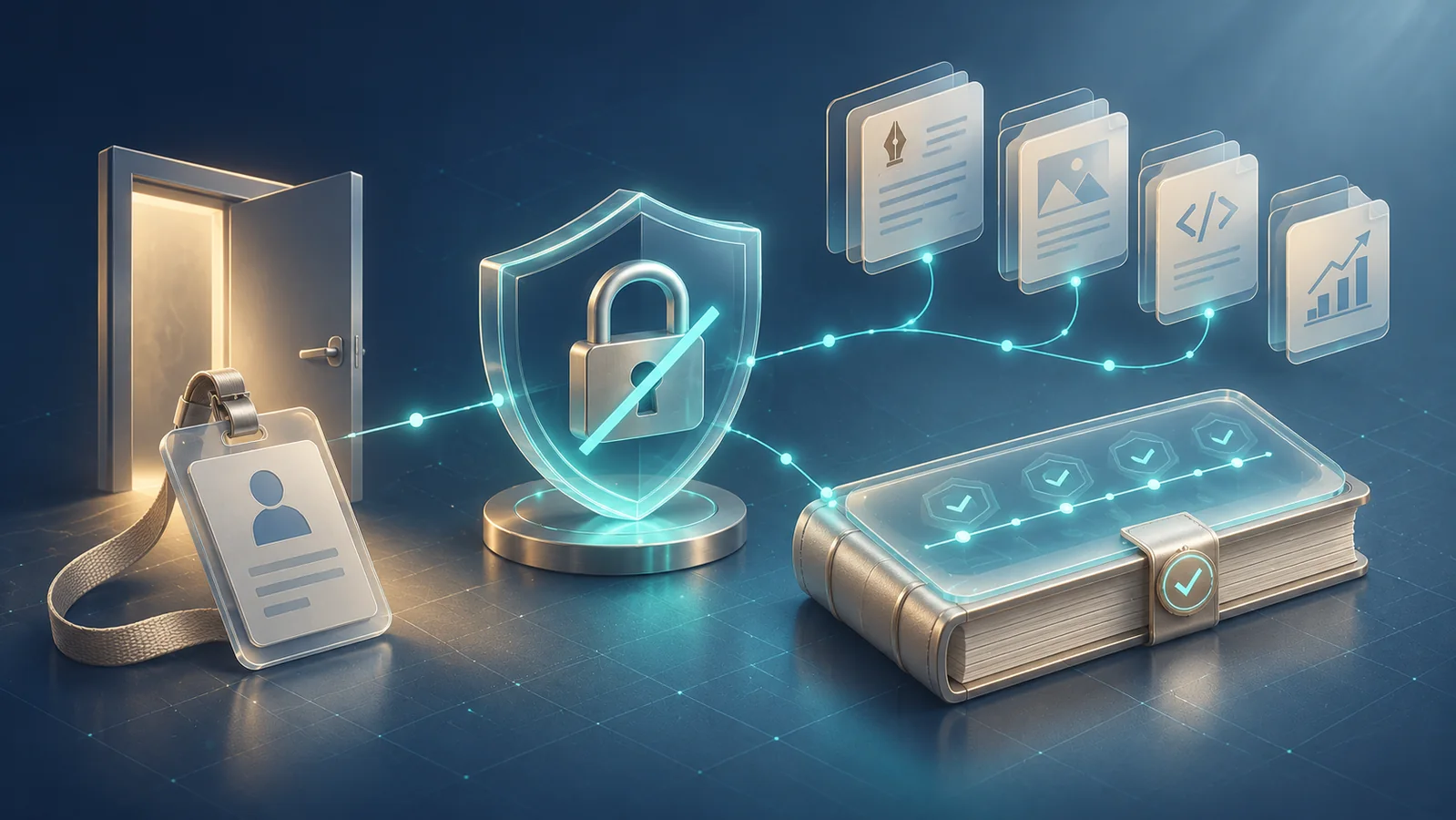
Insider threats and compliance requirements make employee departures difficult to manage: access must be revoked quickly while a reliable audit trail of past actions is preserved. This calls for sound organisational practices, IAM (Identity & Access Management) tools and observability solutions. This article describes the process and its technical architecture, and offers decision-makers guidance on preserving security and institutional memory.
Introduction – A real, often underestimated problem
When Jean Dupont leaves his position as a DevOps engineer after five years at TechCo, the IT department immediately triggers the deactivation of his Active Directory account. Within minutes, access to production servers is blocked; however, several weeks later, an internal investigation reveals that certain modifications made to the CI/CD pipeline were not correctly archived, making it impossible to reconstruct the process that introduced a bug into production.
This scenario illustrates two recurring flaws:
- Overly abrupt revocation – Prioritising the immediate termination of privileges sometimes leads to accounts being deleted before their artefacts (commits, tickets, logs) have been properly archived.
- Loss of traceability – Without a continuous audit mechanism and structured archiving, the employee's contributions disappear or become unusable for legal and technical history.
In an environment where GDPR mandates proof of compliance for processing operations [1], where ISO/IEC 27001 standards require control over access and its history [2], and where unauthorised access incidents represent 30% of reported breaches (ENISA, Threat Landscape 2023) [3], the ability to reconcile the rapid withdrawal of rights with the preservation of traceability becomes a factor in operational resilience.
1. Regulatory Framework & Governance Requirements
| Reference | Primary Obligation | Impact on Off-boarding |
|---|---|---|
| GDPR – Art. 30 | Maintain a record of processing activities, including access to personal data. | Retain access logs and usage metadata after departure. |
| ISO/IEC 27001:2013 – A.9.2.6 | Management of the removal or modification of access rights. | Documented procedure, traceability of revocation actions. |
| NIST SP 800-53 Rev.5 – AC-2 | Access control – deactivation of inactive accounts. | Automation of offboarding within 24 hours following notification. |
| ANSSI – Guide de la sécurité des systèmes d’information (2022) | Implementation of centralised and protected logging. | Centralise logs prior to account deletion. |
These requirements converge towards three pillars: detection, preservation, and auditability. Any off-boarding process must therefore:
- Identify all identities (individuals, service accounts, API keys) linked to the employee.
- Capture produced artefacts (code, configurations, tickets, emails) before deletion.
- Archive these artefacts in an immutable and searchable repository.
2. Technical architecture of a secure offboarding process
2.1. Key components
┌─────────────────────┐      ┌───────────────────────┐
│   Source HR System  │──►──►│   Orchestrateur (IAM)  │
└─────────▲───────────┘      └───────▲───────▲───────┘
          │                         │       │
          │ 1. Notification de     │2. API │3. Trigger
          │    départ              │calls │   revocation
          ▼                         ▼       ▼
┌─────────────────────┐      ┌───────────────────────┐
│   Identity Store    │◄─────│   Access Review DB    │
│ (AD/LDAP, IdP)      │      │  (approbations)       │
└─────────▲───────────┘      └───────▲───────▲───────┘
          │                         │       │
          │4. Déprovisionnement    │5. Export│6. Purge
          ▼                         ▼       ▼
┌─────────────────────┐      ┌───────────────────────┐
│   Logs & SIEM        │◄─────│  Archivage Immutable   │
│ (Splunk, ELK)        │      │  (WORM, Object Store) │
└─────────────────────┘ └───────────────────────┘- HR System: event trigger (contract termination notification).
- IAM Orchestrator: automation engine (e.g. Azure AD Identity Governance, SailPoint) that orchestrates API calls to cloud services, SaaS platforms and on-premise systems.
- Access Review DB: decision table containing manager approvals, sensitivity levels and retention requirements.
- Deprovisioning: revocation of user accounts, API tokens, certificates, sudo rights, etc.
- Export / Archiving: automated extraction of logs (authentication, resource actions) and artefacts (Git commits, JIRA tickets, SharePoint documents).
- Secure purge: permanent deletion following the legal retention period.
2.2. Key technical points
| Domain | Best practices | Tools / References |
|---|---|---|
| Identity and Access Management (IAM) | Apply the principle of least privilege; implement role-based access control (RBAC) and just-in-time (JIT) access for critical systems. | Azure AD PIM, AWS IAM Access Analyzer, HashiCorp Vault |
| Logging | Enable native logging (Windows Event Forwarding, CloudTrail, auditd); centralise within a SIEM using tamper-evident storage. | Splunk Enterprise Security, Elastic Stack, IBM QRadar |
| Log Integrity | Sign log streams (HMAC, RSA-SHA256) and store them in Write-Once-Read-Many (WORM) mode. | AWS Glacier Vault Lock, Azure Immutable Blob Storage |
| Code & Metadata Archiving | Export the full git history, including author and date metadata; retain within an immutable repository or a secure software supply chain solution. | GitHub Enterprise Archive, GitLab Geo, JFrog Artifactory |
| Key & Secret Management | Immediately revoke API keys, certificates, and OAuth tokens; mandatory rotation prior to account deactivation. | HashiCorp Vault, AWS Secrets Manager, Azure Key Vault |
| Orchestration and Workflow | Implement an automated off-boarding playbook (Ansible, Terraform, PowerShell DSC) triggered by the HR system via webhook. | ServiceNow HR Service Delivery, Microsoft Power Automate |
3. Business Process: From Departure Notification to Final Purge
3.1. Detailed Operational Steps
| Phase | Action | Owner(s) | Target timeframe |
|---|---|---|---|
| A – Notification | Entry of the end date in the HRIS → webhook trigger. | HR, Line Manager | D-0 |
| B – Validation | Manager confirmation, identification of critical access (production, sensitive data). | Manager, CIO, CISO | D+1 |
| C – Pre-departure capture | Export of access logs for the previous 30 days, workspace backup (Git, SharePoint, Confluence). | IAM / DevOps | Day +2 |
| D – Progressive Revocation | AD account disablement, removal of RBAC groups, and token revocation. Use of JIT for any remaining necessary temporary access (e.g., audit). | IAM, System Administrator | Day +3 |
| E – Post-revocation Audit | Verification of the absence of active access via SIEM; generation of the audit report. | CISO, Internal Auditor | Day +5 |
| F – Immutable Archiving | Ingestion of logs and artefacts into WORM storage; creation of a reference hash for proof of integrity. | CIO, Compliance Officer | D+7 |
| G – Purge | Permanent deletion of the account and associated secrets following the legal retention period (e.g., 3 years under GDPR). | IAM, Cloud Service | D+365* |
\* Retention periods depend on the legal jurisdiction (e.g., tax records for 6 years, sector-specific requirements).
3.2. Roles and Responsibilities – RACI Matrix
| Task | Responsible (R) | Accountable (A) | Consulted (C) | Informed (I) |
|---|---|---|---|---|
| Departure entry in the HRIS | HR | Manager | IT Department | Employee |
| Validation of critical access | Manager | IT Department | CISO, Compliance Officer | HR |
| Export and archiving of artefacts | IAM / DevOps | IT Department | Security Manager | Internal Auditor |
| Revocation of rights | IAM | IT Department | CISO | HR |
| Closing audit | CISO | DPO | Internal Auditor | Direction |
4. Traceability: ensuring the integrity and availability of contributions
4.1. Detailed Logging
- Authentication: Windows event logs (4624/4634), CloudTrail (AWS), Azure AD sign-in logs – retained for a minimum of 90 days in immutable mode.
- Authorization: IAM policy evaluation traces (e.g., AWS IAM Access Analyzer findings) – archived with the decision context.
- Resource actions: Git operation logs (git log --pretty=fuller), JIRA tickets (issue history), configuration changes (Terraform plan + apply).
- Security events: SIEM alerts correlating access and critical changes – marked as evidence.
4.2. Proof of Integrity
- Hashing: each exported artefact is timestamped and hashed (SHA-256). The digest is stored in an immutable registry (e.g., AWS DynamoDB with versioning).
- Digital signature: log streams are signed at the source (syslog TLS + HMAC) to guarantee that no tampering has occurred.
- Chain of trust: the archiving process creates a Merkle tree which allows, in the event of a dispute, proof that the dataset has not been altered.
4.3. Access to traceability post-departure
- Audit portal: a self-service interface (e.g., ServiceNow Audit Dashboard) allowing legal or audit teams to consult logs without reactivating the account.
- Retention policy: compliance with Article 30 of the GDPR – access metadata remains available for consultation throughout the retention period defined by internal policy.
5. Use case: offboarding a cloud architect in a hybrid organisation
Context – FinTech X employs 250 people, with a mixed environment (AWS, Azure, on-prem datacenter). The lead architect is leaving the company after 7 years. Their role involves access to several AWS accounts (IAM Roles), API access keys, and the management of CI/CD pipelines hosted on GitLab.
5.1. Implementation
| Step | Concrete action |
|---|---|
| Notification | The HRIS generates a webhook to ServiceNow HR Service Delivery. |
| Access inventory | Use of AWS IAM Access Analyzer to list inline policies and resource-based policies. Azure AD Graph API queries security groups. |
| Code export | GitLab CI executes an archive_repo job that clones the repository, creates a tar.gz archive including the full .git directory, calculates the SHA-256, and pushes it to an S3 bucket configured in Object Lock (WORM) mode. |
| Key revocation | AWS Secrets Manager deletes Access Keys; Azure Key Vault revokes certificates. |
| Logging | CloudTrail logs are delivered to a secondary region and stored for 7 years using S3 Object Lock. |
| Final audit | The SIEM generates an activity report covering the period from D-30 to D+5, digitally signed via RSA-2048. |
5.2. Results
- No persistent access detected after 48h.
- All artefacts (code, pipelines, tickets) are archived and searchable for 6 years.
- The process was completed in 4 working days, well below the internal SLA of 10 days.
6. Points of vigilance – what to monitor closely
Points of vigilance
| Risk | Cause | Mitigation measure |
|---|---|---|
| Omission of a service account | Accounts not linked to a user (e.g., CI runners) are not flagged by the HRIS. | Automated inventory via cloud asset inventory and periodic review of stored secrets. |
| Non-immutable logs | Storage on shared disks without write-locking. | Use WORM solutions (Object Lock, Azure Immutable Blob). |
| Partial revocation | Deactivation scripts that do not cover nested AD groups or conditional IAM permissions. | Centralised orchestration using policy as code (OPA, Terraform Sentinel) to ensure full coverage. |
| Violation of the proportionality principle | Immediate deletion of personal data before the employee can retrieve their private files. | Separate corporate data from personal data; provide a handover process (e.g., secure box). |
| SIEM performance degradation | Massive log ingestion during offboarding may saturate the pipeline. | Schedule exports in multiple waves, and enable back-pressure and rate limiting. |
7. Technical & organisational limitations
- Complexity of hybrid environments – The multiplicity of providers (AWS, Azure, GCP, on-prem) makes process standardisation difficult. Centralised governance via an Identity Fabric (e.g., ForgeRock, PingOne) is often necessary, but involves significant initial investment.
- Variable legal retention periods – Requirements differ by jurisdiction (GDPR vs US CCPA law). A catalogue of obligations must be kept up to date, otherwise there is a risk of retaining too much or too little information.
- Resistance to change – Operational teams may perceive offboarding automation as a loss of control. Change management (training, communication) is crucial to gain buy-in.
- Cost of immutable solutions – WORM storage, while secure, can lead to an additional cost of 10% to 30% compared to standard storage. A cost-benefit analysis must be performed based on the volume of archived logs.
Operational Conclusion
Revoking a collaborator's access while preserving the traceability of their contributions is not merely a technical task, but a cross-functional process